

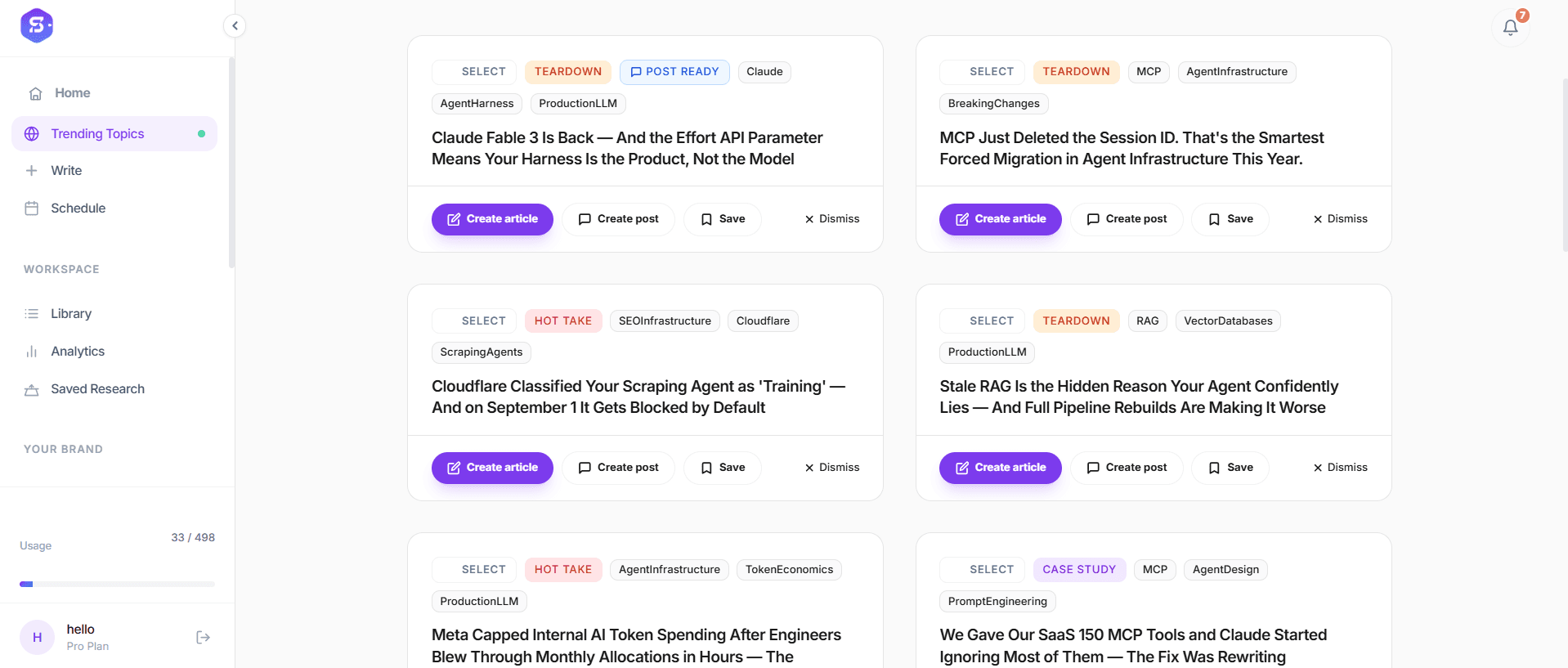
Most people who want to build authority online do not struggle with writing. They struggle with knowing what to write about before the moment has already passed. By the time a topic feels obvious enough to post about, the conversation has usually moved on and everyone else is already covering it. Radar exists to close that gap before it opens.
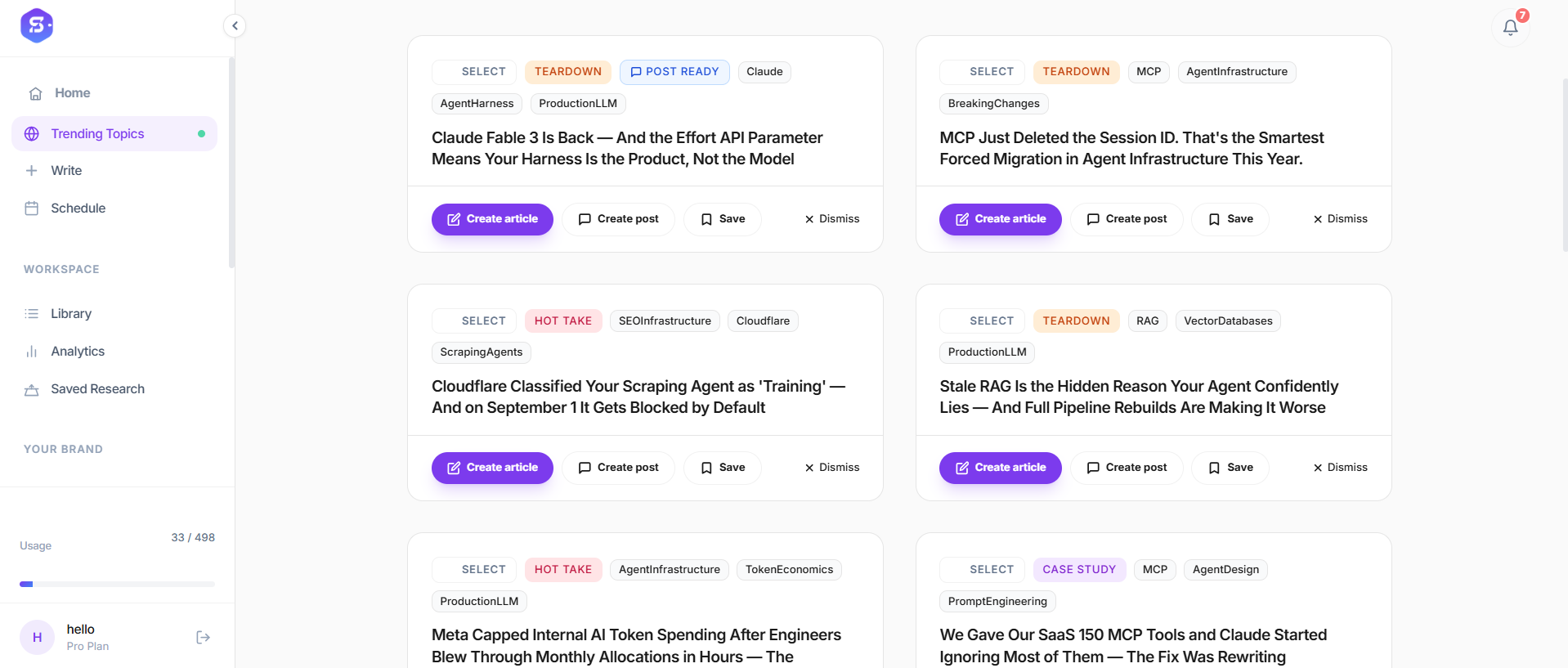
What Is SelfBrand AI Radar and How Does It Work?
Radar is the trend research feature inside SelfBrand. It runs on an automated weekly cycle, so the research happens in the background instead of eating into the time you have for actual writing. Most people trying to stay visible online end up doing this manually, switching between platforms and trying to remember what they saw the week before. Instead of opening five tabs and guessing what is worth covering, the Radar feature shows what is already gaining traction in your niche, so you start from real signals instead of a blank page.
1. Automated weekly scanning. Radar scans Reddit, LinkedIn and Quora on a fixed weekly schedule without needing you to run a search or remember to check anything. The scan happens whether you log in that day or not, so the research keeps moving even during weeks you are heads down on client work.
2. Signal grouping by topic, intent and urgency. Raw mentions across three platforms do not mean much on their own, so Radar groups them by topic, by the intent behind the conversation, and by how urgent or time-sensitive the trend is. A question that just started appearing across multiple subreddits gets treated differently from a slow-moving debate that has been circulating for months.
3. Brief-ready hand-off. Once signals are grouped, Radar hands them off as structured insights rather than a raw list of links. That output becomes the starting point Co-Author uses to help shape a draft, which means the gap between finding a topic and writing about it shrinks from hours to minutes.
Why Reddit, LinkedIn and Quora Specifically?
Each of these platforms surfaces a different layer of the same conversation, and no single one gives the full picture on its own. Radar treats them as complementary sources rather than interchangeable ones.
1. Reddit surfaces the unfiltered version of a question. Inside niche subreddits, people ask the blunt version of a question before they would ever phrase it that way on LinkedIn. That unfiltered phrasing is often closer to what someone would type into Google or ask an AI assistant.
2. LinkedIn shows what is gaining traction in professional feeds. LinkedIn reveals which topics other practitioners and companies in your space are already discussing publicly, including the angles getting engagement and the ones falling flat. That shows not just what is trending, but what a professional audience is willing to engage with.
3. Quora exposes the exact phrasing people search for. Quora questions tend to mirror real search behavior more closely than social posts do, since people go there specifically to ask something they could not answer themselves. That phrasing is useful for matching content to how your audience is actually searching.
How Radar Compares to Manual Research and Google Trends
Most people who try to keep up with what is trending in their niche default to one of two habits: checking platforms manually, or leaning on a tool like Google Trends for search volume. Both approaches have real limits that show up once you compare them side by side.
Approach | Platforms covered | Time required per week | Output format |
Manual multi-tab research | Depends on memory and habit | 2-4 hours | Scattered notes or bookmarks |
Google Trends alone | Search volume only | 30-60 minutes | Raw keyword volume, no context |
SelfBrand Radar | Reddit, LinkedIn and Quora | 0 (runs automatically) | Grouped, brief-ready signals |
Manual research is not sustainable because it competes directly with the time you would otherwise spend writing. Google Trends shows search volume without the context of why a term is rising or what people are actually asking, which leaves the interpretation work entirely up to you.
Which Industries Does Radar Cover?
Radar is not built around one niche. It is designed to work across the range of industries where personal expertise and public visibility intersect, since the reader who benefits most is someone with real domain knowledge rather than a generalist content creator.
SaaS founders and operators use Radar to track product and positioning conversations happening in real time.
Consultants and agency owners use it to catch the specific problems prospects are actively describing online.
Creator economy professionals use it to spot format and platform shifts before they become obvious.
Developers and technical builders use it to follow tool comparisons and workflow debates inside dev communities.
Marketers use it to catch channel and strategy discussions as they gain traction rather than after they peak.
Fintech professionals use it to track regulatory and product conversations moving through finance-focused communities.
AI practitioners use it to stay ahead of tooling and workflow discussions in a space that shifts weekly.
Startup founders use it to see which problems their target market is describing before a competitor addresses them publicly.
The Trend-to-Draft Gap (and How Radar Closes It)
There is a consistent pattern behind content that arrives too late to matter. Call it the trend-to-draft gap: the time between when a topic starts gaining real traction and when someone with genuine expertise finally publishes something about it. For most people that gap runs one to two weeks, which is long enough for the topic to have cooled by the time they post.
That gap exists because finding the signal usually takes as much effort as writing about it, so research gets pushed off until there is a clear block of free time. By the time that block appears, the topic has often already been covered by three other people in the same space, which flattens whatever advantage being early would have given you.
Radar closes the gap by running the research continuously in the background, so the signal is already grouped and ready the moment you sit down to write. The remaining work is the part that actually requires you: deciding what you think about the trend and putting it into words.
How to Use Radar to Build a Weekly Content Habit
Having access to trending signals only helps if there is a repeatable way to act on them. The following pattern is what separates people who use Radar consistently from people who check it once and forget.
1. Start from urgency-ranked signals, not the oldest ideas in your list. Work through Radar's most urgent or fastest-moving signals first, since those are the topics with the shortest shelf life. Older, slower-moving ideas can wait because they are not losing relevance week over week.
2. Match the signal to your specific angle, not the general topic. A trending topic on its own is not a content idea. Filter every signal through the specific experience or opinion only you can add, since that is what turns a shared trend into something worth publishing under your name.
3. Move from signal to draft in the same week. Treat the week the signal appears as the deadline for turning it into a draft, even a rough one. Waiting past that window is usually what recreates the trend-to-draft gap Radar was supposed to close.
The Bottom Line
The pattern behind most invisible experts is not a lack of knowledge. It is spending research time figuring out what is trending instead of building the argument only they can make about it. Radar removes that research bottleneck by running the scan every week, so the topics are already sorted and waiting by the time you have room to write.
What is left after that is the actual skill: forming an opinion, backing it with real experience, and publishing it while the conversation is still open. That is the part no scanning tool can do for you, and it is also the part that builds the kind of recognition a generic post never will.
