

ImBRAND can turn a photo or voice note into a social post in minutes, while SelfBrand AI starts earlier by finding the questions your audience is already asking. That difference makes ImBRAND vs SelfBrand AI less about which AI writer has more features and more about whether you want fast, personality-led posts or research-backed authority. I compared both workflows to identify the creator each one actually serves.
ImBRAND vs SelfBrand AI at a glance
The fastest way to understand these tools is to compare their starting inputs. ImBRAND asks for a photo, voice note, or quick idea, while SelfBrand's personal branding software starts with a live research signal, your expertise, or an existing point of view.
| Category | ImBRAND | SelfBrand AI |
|---|---|---|
| Best for | Coaches, creators, and visual personalities who need frequent social posts | Founders, consultants, job seekers, and experts building authority around a niche |
| Primary input | Photo, voice note, or short text idea | Audience questions, trend signals, research briefs, or expert notes |
| Core output | Short social posts, carousels, and video scripts | LinkedIn posts, Quora answers, and research-backed articles |
| Topic discovery | A seven-day plan based on your Brand Map | Radar scans Reddit, LinkedIn, and Quora for rising questions and confusion clusters |
| Voice system | Brand Map stores tone, values, style, and goals | Voice Profile guides Co-Author while the expert supplies judgment and lived experience |
| Distribution | Scheduling and auto-posting across major social networks | Approval-based publishing designed around an authority workflow |
| Current price signal | Free manual tier; App Store lists Pro at $29 monthly or $199 annually | SelfBrand lists plans from $19 to $99 per month |
My short verdict is simple. Choose ImBRAND when your raw material is the life you are already documenting; choose SelfBrand when your raw material is expertise that needs to become discoverable.
How to compare ImBRAND and SelfBrand AI with the Input-to-Authority Framework
I use the Input-to-Authority Framework to compare personal branding tools because feature counts hide the decision that matters. The framework scores a workflow across four stages: capture, signal, substance, and shelf life.
1. Capture: How easily can you contribute something real?
ImBRAND has the lower-friction capture model. Its public product page accepts three inputs, photo, voice, and text, and says a Brand Map can be set up in under 10 minutes. That is useful when a client session, event photo, or spoken observation is already the story.
SelfBrand asks for more deliberate input because the output is meant to make a professional's expertise legible. Its authority workflow connects positioning, research, writing, and publishing, so setup is closer to building an editorial system than making a quick caption.
2. Signal: Does the tool know what the audience cares about now?
ImBRAND's Weekly Content Plan supplies seven days of niche-specific ideas based on the user's audience and brand style. That solves the blank-page problem, but its public materials do not say those ideas come from live external conversations or search demand.
SelfBrand Radar scans three named sources, Reddit, LinkedIn, and Quora, then groups signals by topic, intent, and urgency. For someone building a thought leadership platform, that research layer matters because a defensible opinion begins with a real question, not a generic prompt.
3. Substance: What does the workflow ask the human to add?
ImBRAND asks for personality, context, and a moment worth sharing. SelfBrand asks for experience, evidence, and interpretation, then uses Co-Author to give that thinking a publishable structure.
4. Shelf life: How long can the output keep creating value?
An Instagram caption or timely LinkedIn post is optimized for the feed. A research-backed article or direct answer can also rank in search and become source material for AI answer engines, which is why SelfBrand is the stronger fit for experts working on visibility in ChatGPT and other AI search tools.
ImBRAND is better for photo and voice-note content
ImBRAND is unusually clear about its job: capture something from your day and convert it into a polished post. Its six-feature public set includes a Brand Map, Weekly Content Plan, Post from Photo, Post from Voice, multi-social publishing, and scheduling.
That combination fits three recognizable workflows:
A coach can upload a photo after a workshop and turn the lesson behind it into a caption.
A creator can record a rough voice note while an idea is fresh and receive a shorter, organized version.
A busy entrepreneur can prepare a week of posts and schedule them across Instagram, LinkedIn, Facebook, TikTok, X, and YouTube.
The mobile orientation is concrete. Apple's current listing says the app requires iOS 18 or later, supports iPhone and Apple-silicon Macs, and offers English and Russian. This is not just a writer with a mobile wrapper; capture is the center of the product.
That strength also defines the limit. A photo proves that something happened, but it does not reveal which question buyers are researching or which misconception is rising in a niche. ImBRAND is strongest when the creator already has the moment and needs help expressing it.
SelfBrand AI is better for research-backed authority
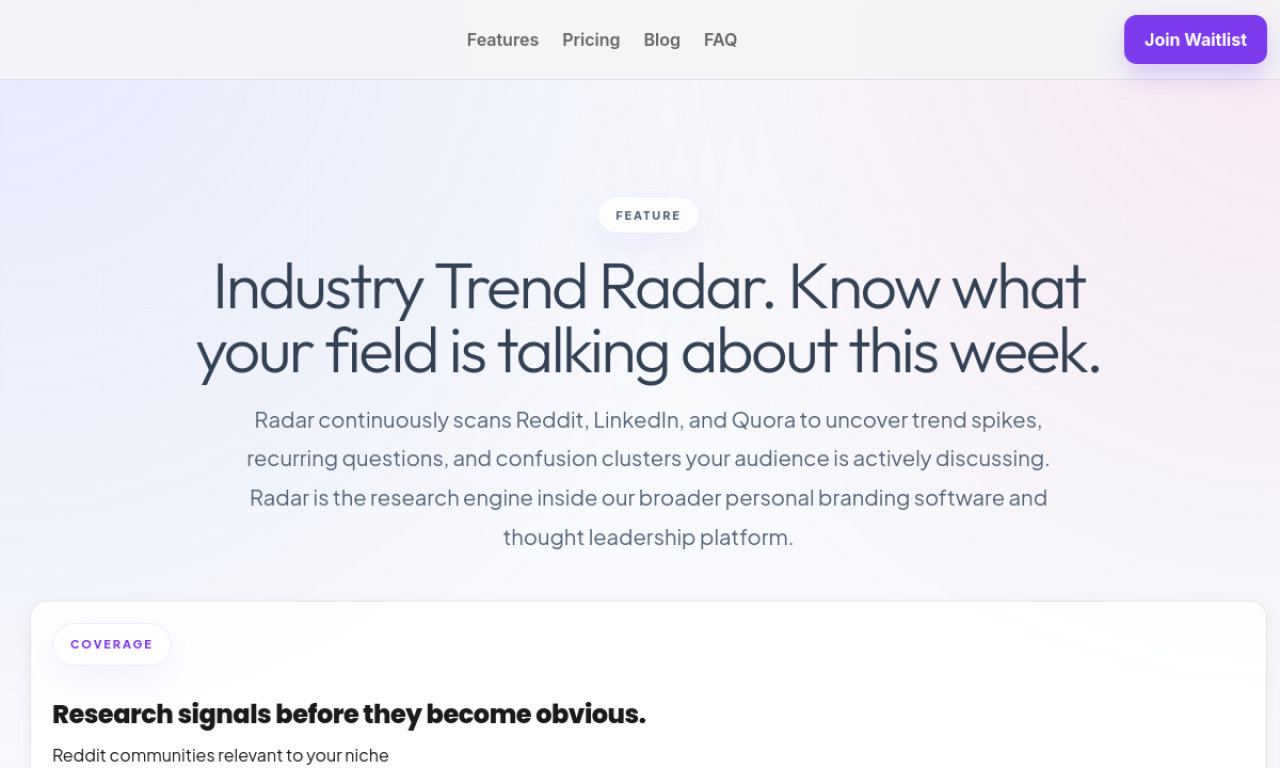
SelfBrand begins where ImBRAND's public workflow stops: external demand. Its Radar research engine continuously scans Reddit, LinkedIn, and Quora for trend spikes, recurring questions, and confusion clusters, with automated weekly scans and rolling updates.
The practical difference is topic quality. “Share a lesson from this event photo” can produce a good social post; “Why are seed-stage SaaS founders struggling to explain AI costs to buyers this week?” can produce a position that earns citations, conversations, and qualified inbound.
Radar then passes brief-ready insights into Co-Author instead of leaving the user to move notes between separate tools. That closed handoff supports professionals who want a durable research-first topical authority strategy, not merely a full content calendar.
This makes SelfBrand a better fit for consultants, technical founders, operators, and career changers whose value sits inside what they know. Their bottleneck is rarely a lack of photos; it is converting private expertise into public evidence.
Which tool produces content that sounds more like you?
Both products make a voice-consistency claim, but they collect identity differently. ImBRAND's Brand Map stores voice, tone, style, values, strengths, vision, and goals, then applies that profile to posts created from user inputs.
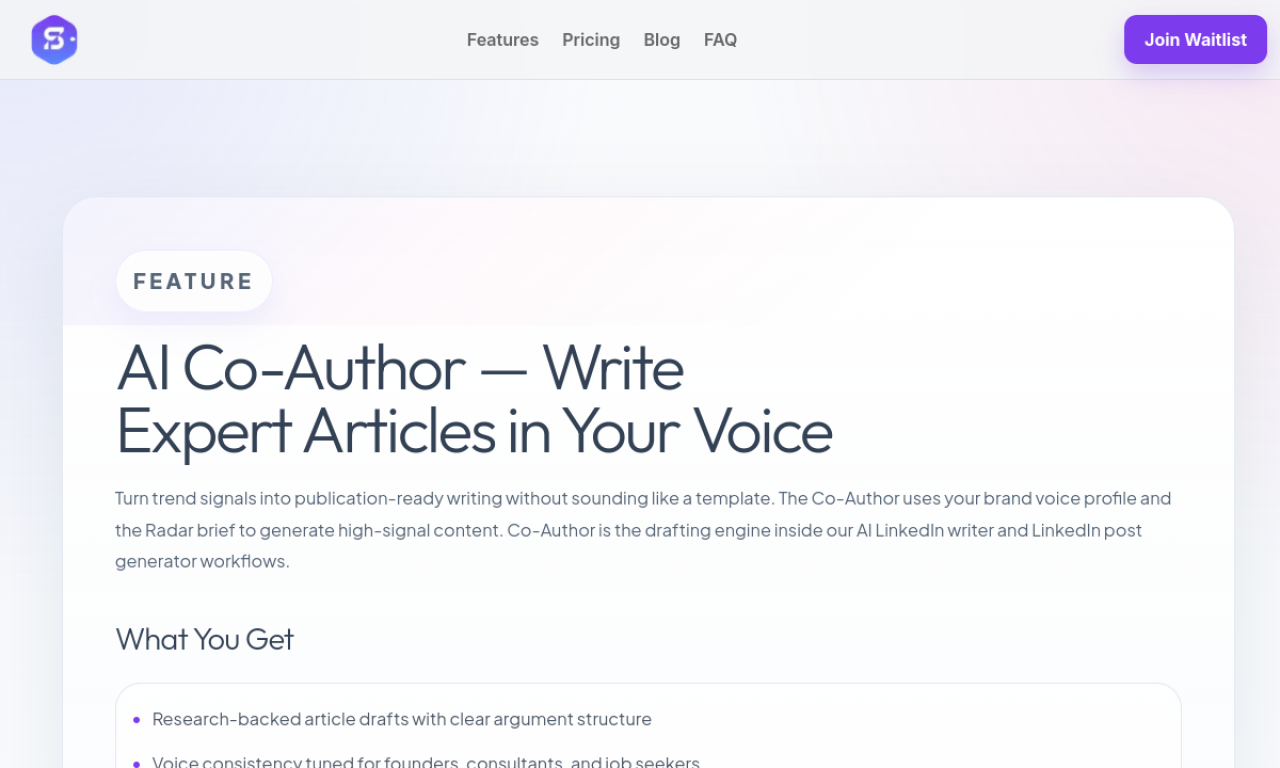
SelfBrand's Co-Author combines a stored Voice Profile with a Radar brief. Its AI Co-Author produces research-backed drafts and platform variants for LinkedIn, Quora, and long-form blogs while leaving the expert responsible for the judgment that makes the piece credible.
I would not declare a universal voice winner without blind output testing from the same person. The more useful distinction is that ImBRAND models how you present yourself, while SelfBrand also structures what you know around evidence and audience demand.
If generic phrasing is your main concern, evaluate both tools with the same three inputs: a past post you like, a contrarian opinion, and a story with specific details. SelfBrand's guide to whether AI-generated content can sound like you explains why vocabulary alone is not enough; recognizable voice also depends on rhythm, framing, and the kinds of claims you make.
Content formats and publishing: breadth versus depth
ImBRAND has the broader public distribution claim. It supports text posts, carousels, and video scripts, then schedules or publishes across Instagram, LinkedIn, Facebook, TikTok, X, YouTube, and other networks.
SelfBrand supports platform variants for LinkedIn, Quora, and long-form blog content. Its LinkedIn content creation workflow is therefore narrower in visual format but deeper in argument structure and search alignment.
This creates a clean decision rule:
Pick ImBRAND if one captured moment needs to become frequent, platform-ready social content.
Pick SelfBrand if one audience signal needs to become a LinkedIn post, a substantive answer, and an article that compounds.
Neither workflow removes the need for review. ImBRAND can polish a weak observation, and SelfBrand can structure an underdeveloped opinion, but neither can manufacture firsthand expertise that the user does not possess.
ImBRAND vs SelfBrand AI pricing and access
ImBRAND offers a free plan with Brand Map, scheduling, and multi-network posting, but its official FAQ says AI writing is reserved for paid tiers. The US App Store listing currently shows Pro at $29 per month or $199 per year, plus optional credit packs from $1.99 to $9.99.
SelfBrand's current buyer guide lists plans from $19 to $99 per month with AI included at every tier. Because features and access can change, check the live SelfBrand pricing page and the relevant app store before subscribing.
Price should follow the job. Paying $29 for fast multi-network social capture is reasonable when consistency is the bottleneck; paying for a research-to-draft system is more rational when one authoritative article can support sales, recruiting, or search visibility for months.
Who should choose ImBRAND?
Choose ImBRAND if most of these statements describe you:
Your best ideas arrive as photos, spoken notes, client moments, or behind-the-scenes observations.
Instagram, TikTok, Facebook, or multi-network scheduling matters as much as LinkedIn.
You want short-form output quickly and do not need a documented external research layer.
You identify more as a creator, coach, or public personality than as a niche analyst.
ImBRAND removes the distance between experiencing something and posting about it. For a visual or faceless creator who already knows the content premise, that speed is the product.
Who should choose SelfBrand AI?
Choose SelfBrand if most of these statements describe you:
Your strongest asset is domain expertise, but it is not visible online.
You need to know what your audience is asking before you decide what to publish.
LinkedIn, Quora, long-form articles, Google, and AI answer engines matter to your reputation.
You want AI to handle research organization and structure while you retain the opinion and evidence.
This is especially relevant to founders building a personal brand, because their content must do more than maintain activity. It needs to make a market, hiring candidate, investor, or future partner understand what they know and why their view is credible.
ImBRAND and SelfBrand AI solve different content problems despite sharing the personal-branding label. Choose ImBRAND to publish the moments you already capture; choose SelfBrand to turn what your market is asking into evidence of what you know.
